Want to learn more? Check out the result guide to dive deeper into the analysis.
01 Shoes’ performance
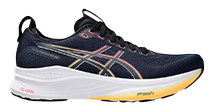
Here you can see how you performed in each pair of shoes. We look at three key metrics, Energy return, Shock absorption and Stride consistency on a scale 0 - 10. The best pair in each category is highlighted with a label.




02 Runner profile
Based on your performance, we reveal which type of runner you are together with the pros and cons characteristic of your profile. There are six fundamental runner profiles and they have been found using cluster analysis on a biomechanical dataset of 50k runners.
Profile composition
Profile strength

Quick Stepper
Profile Overview
Your runner profile has a good performance in long distances due to the high cadence, which helps to reduce the body impact. In order to improve speed performance, you can strengthen your glutes and hamstrings with speedwork and uphill running. This will result in more propulsion and longer strides.
Pros
- Low injury risk due to a quick leg turnover
- Great technique for marathons
- Good bounce capacity
Cons
- The speed performance decreases in the final stretch of the race, as the maximum speed is constrained by the rapid movement of the body segments.
- Passive propultion
General statistics
Runner profile overview


03 Energy expenditure
Energy expenditure is the amount of energy your body uses when running. Energy is spent on work against gravity and work to move the body limbs but energy is also returned in the elastic bounce with the ground.
Mechanical work
+
Elastic energy return
=
Running economy
04 Gait parameters
These are the key parameters behind your Running Profile and Running Economy. The star rating guides you towards optimized performance.


Cadence


Contact time


Overstride


Forward lean


Vertical displacement


Vertical force
05 Rating per shoe
06 Gait kinematics
In this section, you'll find information about your motion patterns, angles, positions, and timings of various body segments and joints during running.
Frontal plane
Knee alignment
Rearfoot rotation
Step separation
Center of mass displacement
Sagittal plane
Hip flexion / extension
Knee flexion


Max hip flexion


Max hip extension


Knee flexion at touch-down


Max knee flexion at stance


Max knee flexion at swing
Footstrike
07 Gait kinetics
In this section, you’ll find information about the forces and torques that act on the body while running. This information helps identify the ideal shoe with the right cushioning and support for your running style.